On9 began in 1999, in a very different landscape. Since then, the work has taken many forms — technology, product, facilitation, coaching, community. Titles changed. Contexts shifted. The work kept asking for attention.
On9 as a Living Practice
This year, I began seeing On9 less as a company and more as a living practice.
In 2013, I wrote a short piece titled How I Choose to Work. It didn’t feel like a turning point then — more like a clarification after years of fatigue and misalignment.
What I was really naming was a boundary.
A choice to stop doing work that required me to shrink myself.
A choice to work at a human pace.
A choice to prioritise honesty, relationships, and learning over speed or appearance.
Looking back now, that piece feels like the quiet beginning of the On9 practice as it exists today.
The work that endured was rarely the most impressive. It was the work where people felt seen, where tension could be named, and where learning unfolded at a human pace.
It’s about the shape of the self that grew through all of it.
Because after twenty-six years, the question is no longer What did I do? but What did the work shape me into? And what shape do I need to become next?
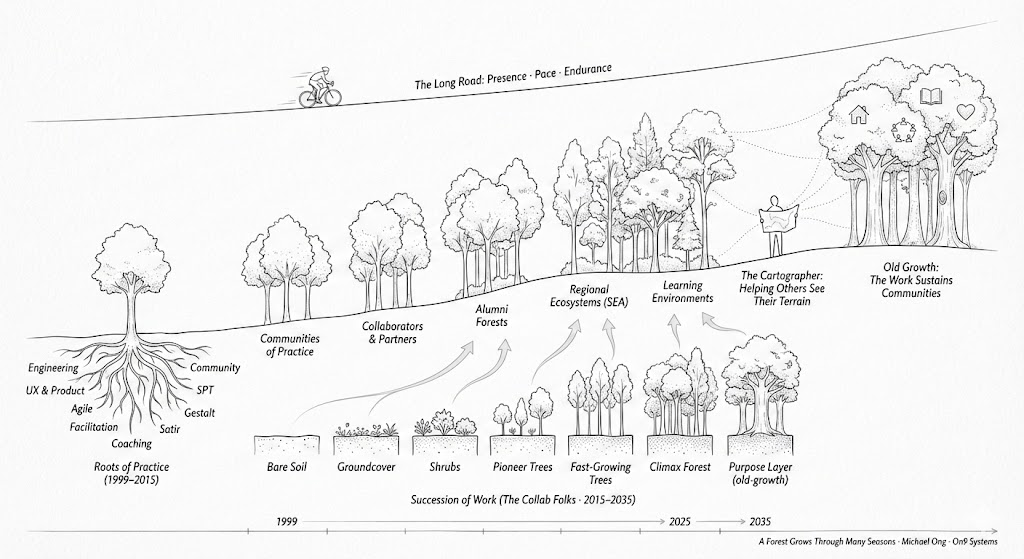
The metaphors that now feel most true are not linear ones. They are living, breathing, ecological.
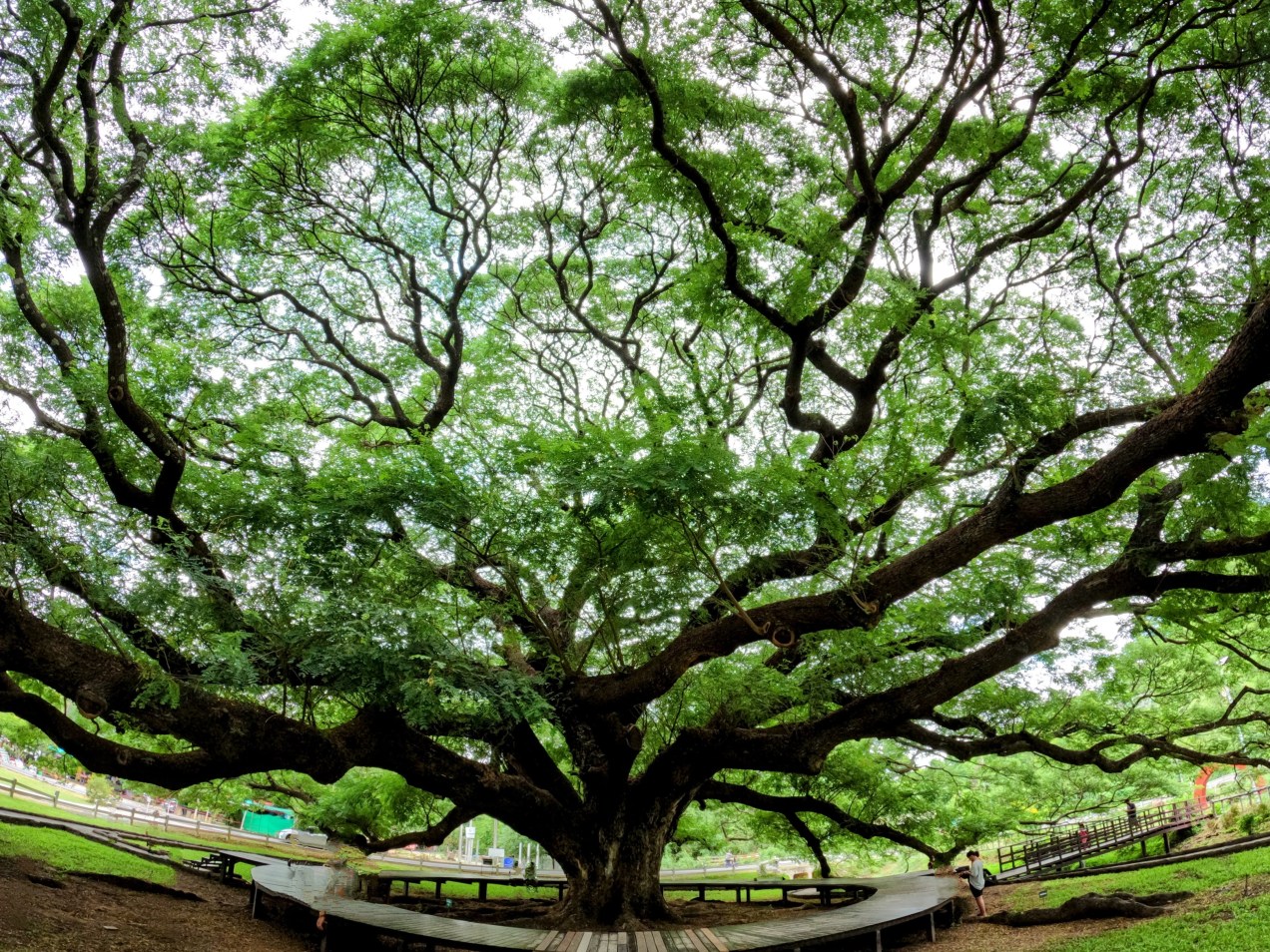
This is a story of a tree. A forest. A map. A long road. And the ongoing work of becoming.
*Visual generated by ChatGPT 5.1 & Gemini 3 Pro + Nano Banana Pro based on my path of using a Food Forest as a metaphor for work
🌱 1. Roots Before Branches: The Ground I Grew From
Before frameworks, before clients, before communities, there were roots:
engineering, architecture, systems thinking
UX, research, product leadership
coaching, facilitation, Satir & Gestalt
somatic practices and the use-of-self
community building, unconferences, shared learning circles
None of these were planned in a straight line. They grew out of necessity first, curiosity second, and meaning third.
Together they formed the underground system that allowed everything else to live.
A tree with one root is fragile. A tree with many roots survives storms.
Twenty-six years taught me that depth isn’t a vertical line — it’s an interconnected root network.
🌳 2. The Trunk: Integrative Practice
A trunk forms slowly, almost invisibly.
Mine emerged through:
thousands of conversations
hundreds of workshops
long cycles of listening, sensing, adjusting
years of walking into complex rooms and learning how to stay present
The trunk is where all the fields meet:
Agile + Product + UX + Experiential learning + Systems thinking Open Space + Satir + Gestalt + SPT + Circle Way Structure + Emergence Discipline + Play
This integration became the centre of my practice. Clients often describe it not as “content” but as clarity, coherence, and a shift in how they see themselves and their system.
That is trunk work.
🍃 3. The Canopy: The Wide Forest of Practice
No tree grows alone.
The work only became meaningful when it became a forest — a network of communities, collaborators, alumni, volunteers, partners, and friends across Southeast Asia.
On9 Systems started in November 1999 with curiosity, code, and the feeling that there had to be a more human way to build things.
I didn’t know then that the next two decades would take me through product leadership, UX, mobile, Agile, capability building, community work, serious play, and hundreds of teams across Southeast Asia and beyond.
The biggest shift is internal: I no longer see myself as someone who “helps teams do Agile / Product / UX better.”
My real work is creating the conditions where people learn, connect, and choose better ways of working together. Across systems. Across cultures. Across whatever emerges.
This update is also a quiet thanks to everyone I’ve worked with — founders, managers, product teams, communities, and friends across SG, MY, ID, TH, VN, TW, PH, JP and beyond. You’ve shaped the coach I’ve become.
Here’s to the next decade of On9 Systems: More connection. More clarity. More play. More work that breathes.
A manifesto for the next decade of work, practice and community
1. We begin with the human system.
Tools matter. Frameworks help. But people change when the environment invites them to — when they feel safe, seen, and capable of facing complexity together. Everything I design begins with this truth.
2. Practice over performance.
We learn by doing, sensing, reflecting and trying again. Not by pretending to have the answers. My work honours emergence, experimentation and the slow craft of mastery.
3. Start with self-leadership.
Teams grow when individuals grow. Leadership is an inside job: awareness → presence → choice → action. Every programme I design begins with this arc.
4. Make space that makes people braver.
Whether through facilitation, coaching, or serious play, my role is to design containers where people can: explore, disagree, stumble, realign — and still stay in the work.
5. Connection is the real infrastructure.
Systems are built from relationships, not charts. Trust, clarity and candour move organisations faster than any method or transformation roadmap.
6. Communities move learning further than companies.
From ProductTonic to PTL to circles and unconferences — communities create the conditions for shared growth, courageous conversations and long-term resilience.
7. Play reveals what seriousness hides.
Cowtopia and other games exist because fun lowers defenses, chaos shows truth, and play lets us see ourselves — and each other — more clearly.
8. Show, don’t tell.
I model the values I teach: transparency, inquiry, humility, and the courage to walk away when a system is not ready for learning.
9. Work with context, not against it.
Every team, every culture, every system is unique. My work adapts: to power, maturity, constraints, edges, timing. There is no one-size-fits-all — only what is possible here and now.
10. Stewardship over scale.
The next decade is not about growing bigger, but going deeper — crafting learning environments, leadership journeys, and communities that last.
The Invitation (2025–2035)
To everyone I work with — leaders, teams, communities, friends:
Let us keep creating spaces of clarity, connection and play. Let us meet complexity with presence and courage. Let us build systems that help people grow into themselves and into each other.
The next decade begins with a simple question:
What wants to emerge when we learn, together, with intention?
After a good long break in the United States meeting people, cycling and enjoying San Francisco, Michigan, Ottawa & New York, I’m embarking on a new journey to apply what I’ve learnt over the last 15 years in technology, user experience design and product management towards mentoring individuals and coaching teams / companies.
I’m currently in the process of setting up a highly flexible team to take on the challenge of providing on-demand skills to startups.
After a good long 8 years (Sept 2006 to Sept 2014), have finally moved servers out of Viewqwest and stopped hosting services.
The 3 servers (Dell Poweredge 850 and 860 x 2) have been inactive for better part of 2 years now. Only the 850 has been humming along for close to all 8 years with 3-4 reboots. CentOS (Linux) FTW!
I’ve worked with customers who cover different fields of industry, and range in size from one-person operations to listed companies since 1999. For customers large or small, I offer the same customer orientated approach.
Most people choose to work for a company.
I choose to work with a customer and walk away when the time is right or it’s no longer the right environment.
I’m not getting paid a salary, I’m getting paid for the service (hopefully good in their eyes) of improving processes and solving their problems.
This is why OT & Appraisals are a foreign concept to me since I don’t generally care about them. I also find the concept of “my boss” strange which might make it odd to work with me for some people. Technically you are my customer whom I don’t always think is right 😉
This approach has a great positive benefit of finding better customers to work with over the past 14 years.
The downside? Some customers are better than others and it can get hard to walk away when you make new friends and get into new areas of responsibility. My current customer is a 2.5 year long project that I originally thought would be 4-5 years long so it’s definitely tough to leave.
For those asking me when is my last day at iProperty, it happened already for me on 1st May but I just so happen to have a 3 months notice period. I guess you’ll know when the day is when I stop posting stuff on Yammer.
It’s kinda nice to have only ONE project to focus on now. The odd thing is I find myself holding back on comments on most things now coz “stepping on people’s toes” isn’t so nice when you are leaving and can’t repair the damage if the person is actually ok out of work context.
My next customer is going to be in an industry which is foreign to me (for now) but the concepts are not. E-commerce, Logistics, Analytics & Subscription Service, it’s going to be a great place to practice what I believe in and teach me the important parts about running such a business.
I’m also finally starting up company #4 at the same time (4th time the charm?).
3 companies and many _what not to do_ lessons should (I hope) make this an interesting challenge at the same time.
My goal at 25 year mark (just 10+ years to go) is to create a few more companies, meet new friends, find a few more great customers and hopefully teach some folks along the way some of the stuff I’ve learnt.
Recollecting my thoughts over the past few days since the news.
Steve Jobs (1955 – 2011)
On Oct 5th, I remember waiting up (as I’ve done for a few years now) for Apple’s “Let’s talk iPhone” event. There had been rumours that Steve Jobs might be there and I hoped to “catch” it on the live blogging. After about an hour and a half, I learnt about the new iPhone 4 S and went to sleep. In the morning on the way to work, I was still undecided about getting the phone and after watching the video of the new phone on the iPad, I had pretty much made up my mind. Oct 28th for Singapore!
The day went by pretty uneventfully. There was meetings and even chatted a bit about the new phone with a few colleagues, there’s considerably fewer Apple fans in my current workplace compared to previous but it’s still fun to talk about something new from Apple with people who care.
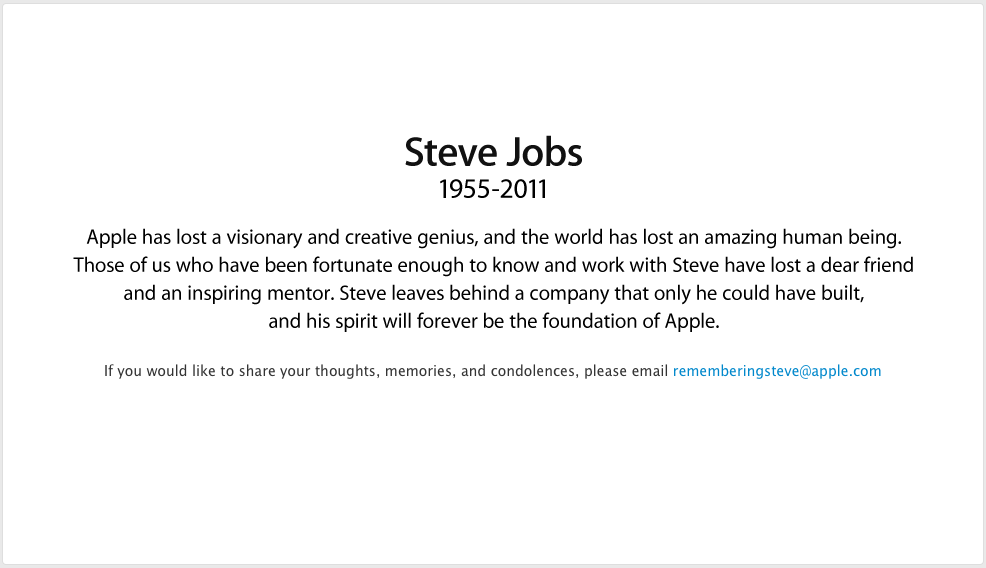
On Oct 6th, it was another typical day, reading news on the iPad on the cab to work. Opened up Tweetdeck and a feeling of dread came over me as I learnt the news about an hour after it had broke on the net. I headed straight up to the office, checked Apple’s website to be sure and there was the man himself and a tribute to his work. We had truly lost a visionary and creative genius.
Remembering Steve Jobs
I’m not a Apple user from Day 1. As a kid, I’ve seen the Mac in use and never really got into it. MS-Dos, Windows were the windows into the PC world. I got into programming on DOS /Windows,Unix (HP-UX) and discovered Linux soon after. Apple didn’t really enter my life till quite late when I got my first iPod Nano. It changed my life from then on with a simple concept of being a work of art serving music.
When the iPhone got released, most people were still using candy bar phones from Ericsson or Nokia. It was not until the iPhone 3GS that I experienced queuing up for the first time for an Apple device. Unboxing it was a change that now has seen me not purchase any Microsoft product since 2009. When I look back at how Microsoft squandered their lead especially in Smartphones, it’s amazing how Steve Jobs created a new product category that has dominated smartphone usage.
For the past year or so, I’ve been toggling between Windows 7 and Mac OS X. Even as a long time computer user, I definitely have come to see how his vision has changed how computing should be and how product development should be done. I am truly saddened by the loss of a visionary and someone who has innovated and touched everyone with his dedication.
Remembering that I’ll be dead soon is the most important tool I’ve ever encountered to help me make the big choices in life. Because almost everything — all external expectations, all pride, all fear of embarrassment or failure – these things just fall away in the face of death, leaving only what is truly important. Remembering that you are going to die is the best way I know to avoid the trap of thinking you have something to lose. You are already naked. There is no reason not to follow your heart.
…
Your time is limited, so don’t waste it living someone else’s life. Don’t be trapped by dogma — which is living with the results of other people’s thinking. Don’t let the noise of others’ opinions drown out your own inner voice. And most important, have the courage to follow your heart and intuition. They somehow already know what you truly want to become. Everything else is secondary.





 Michael Ong